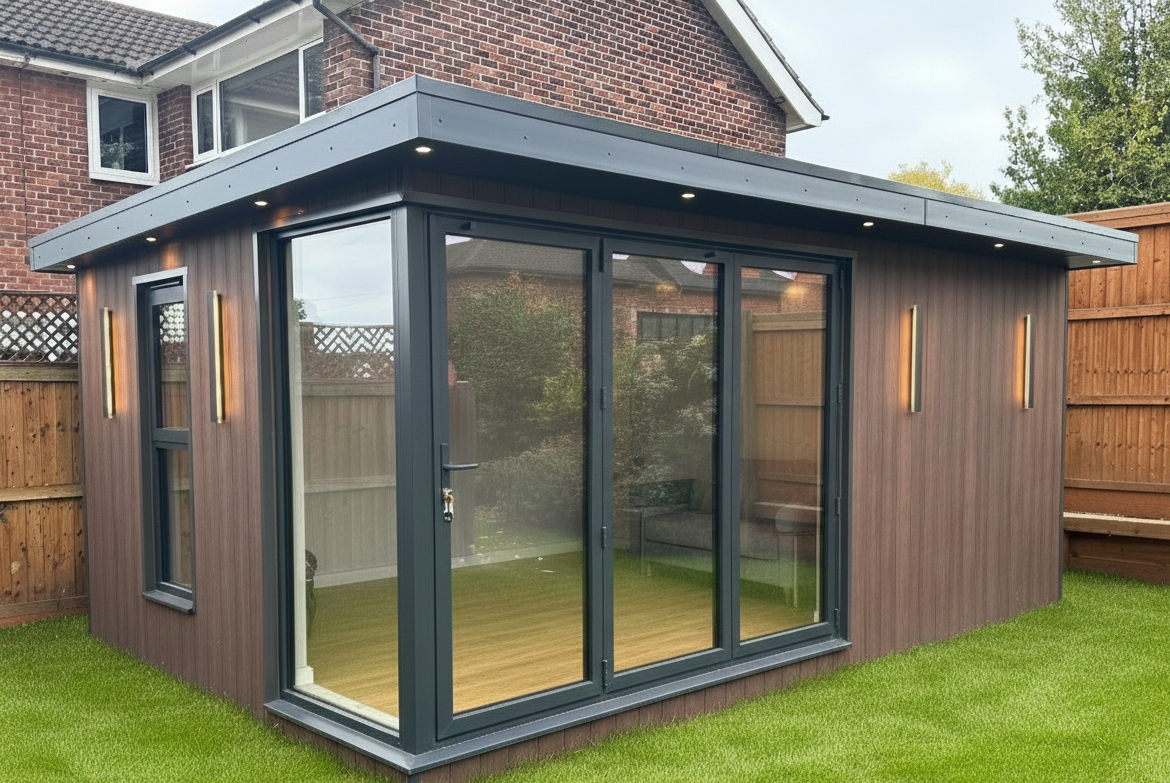
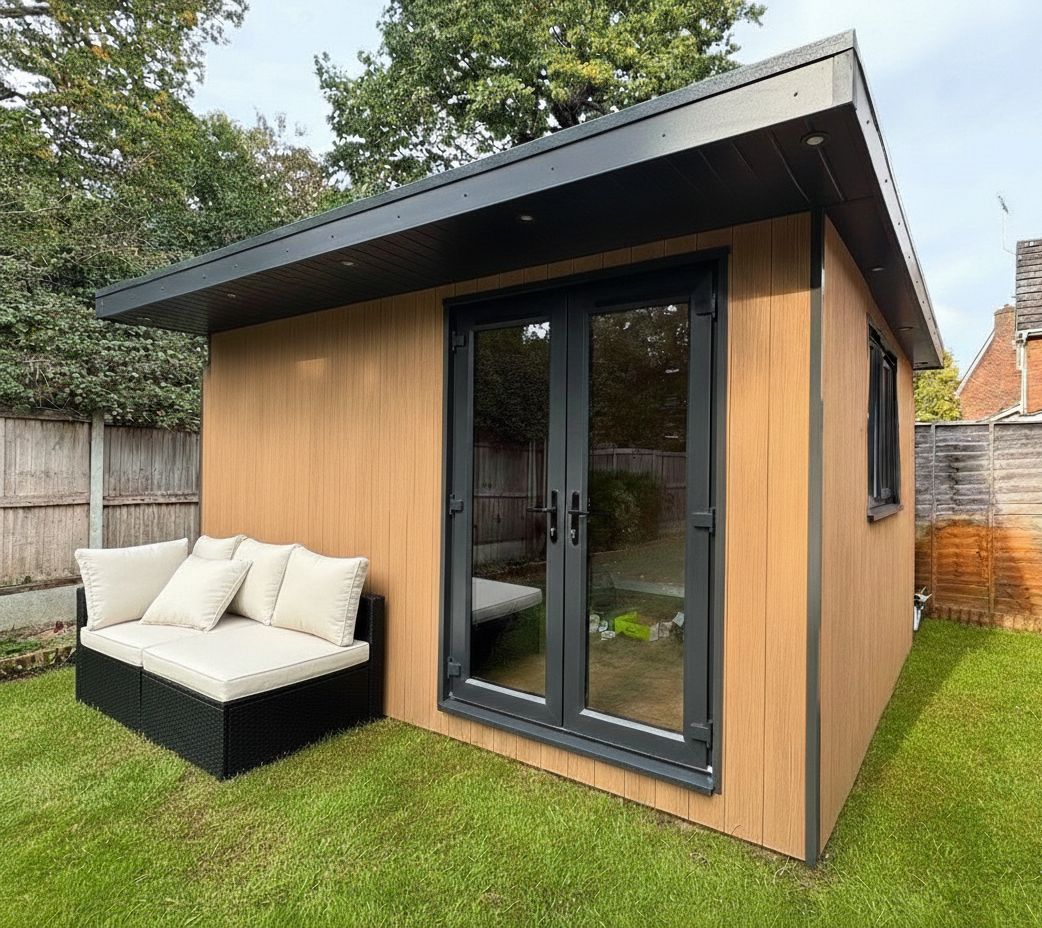
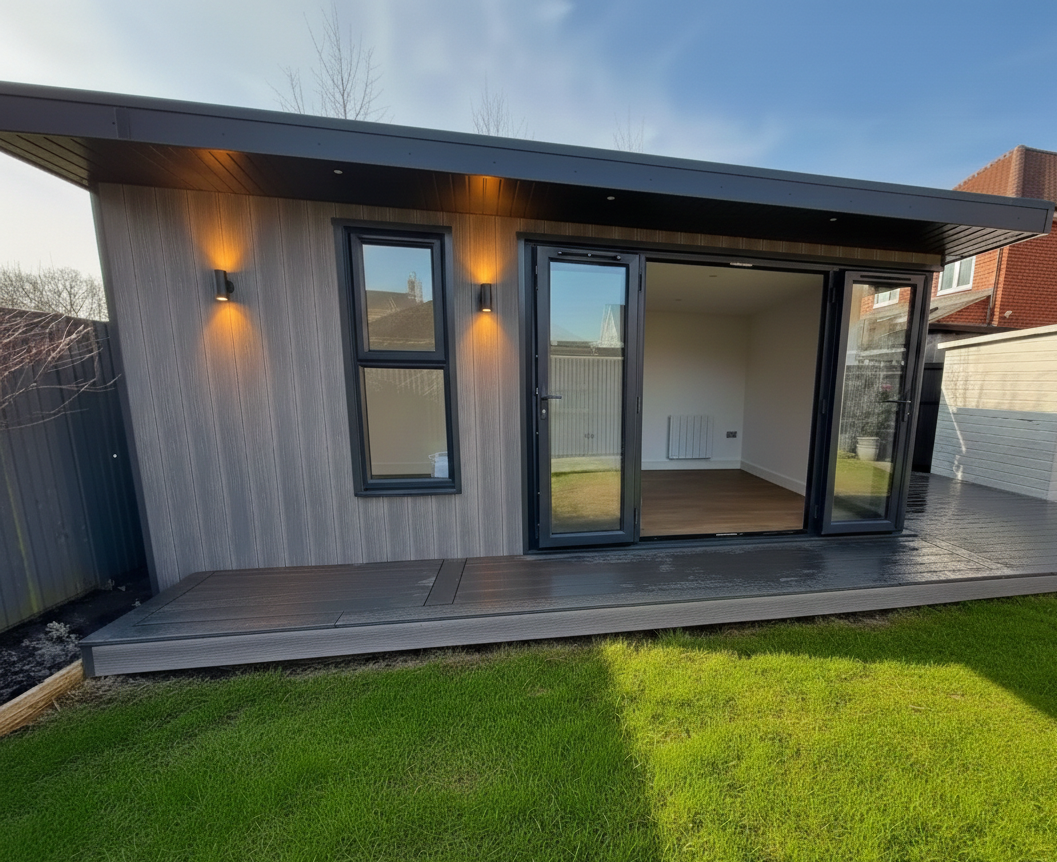
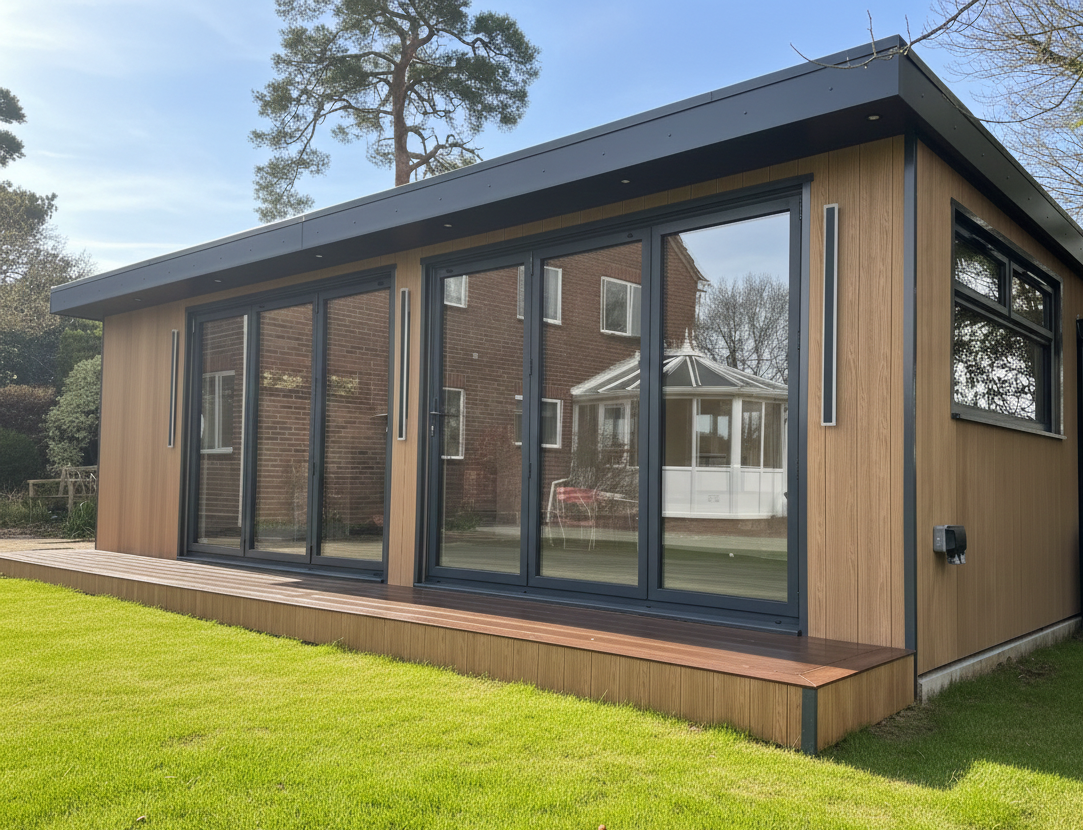
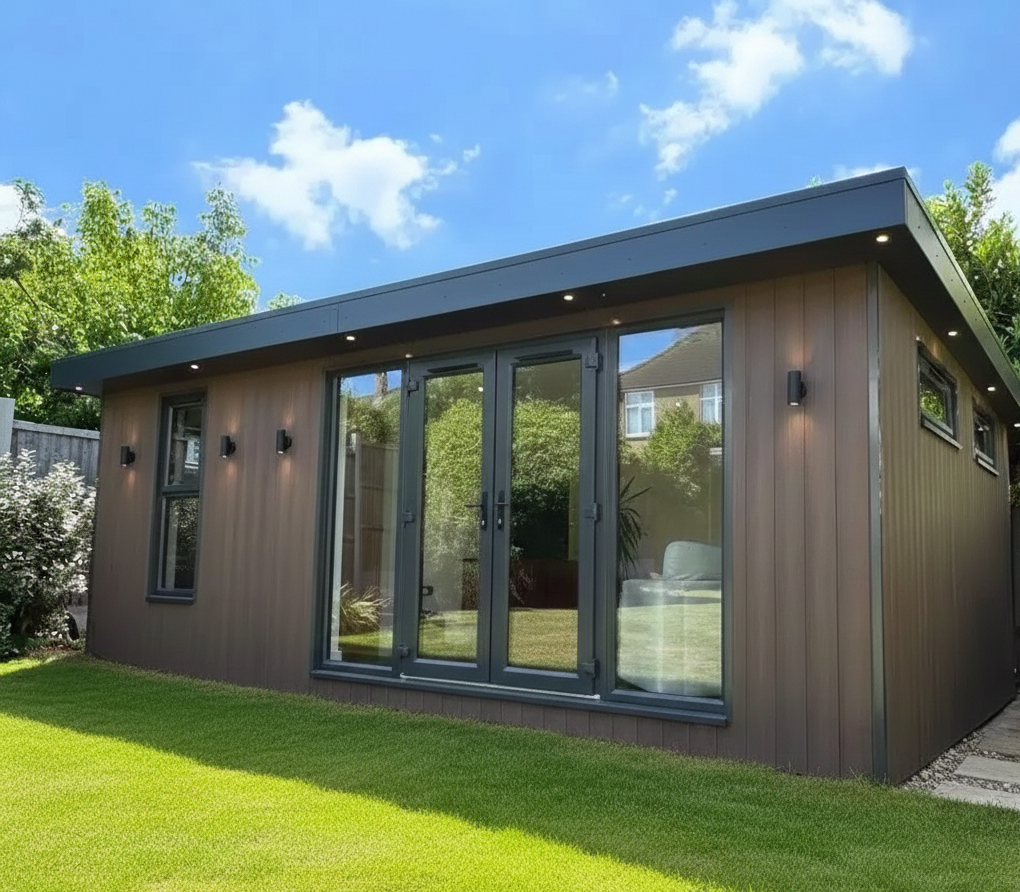
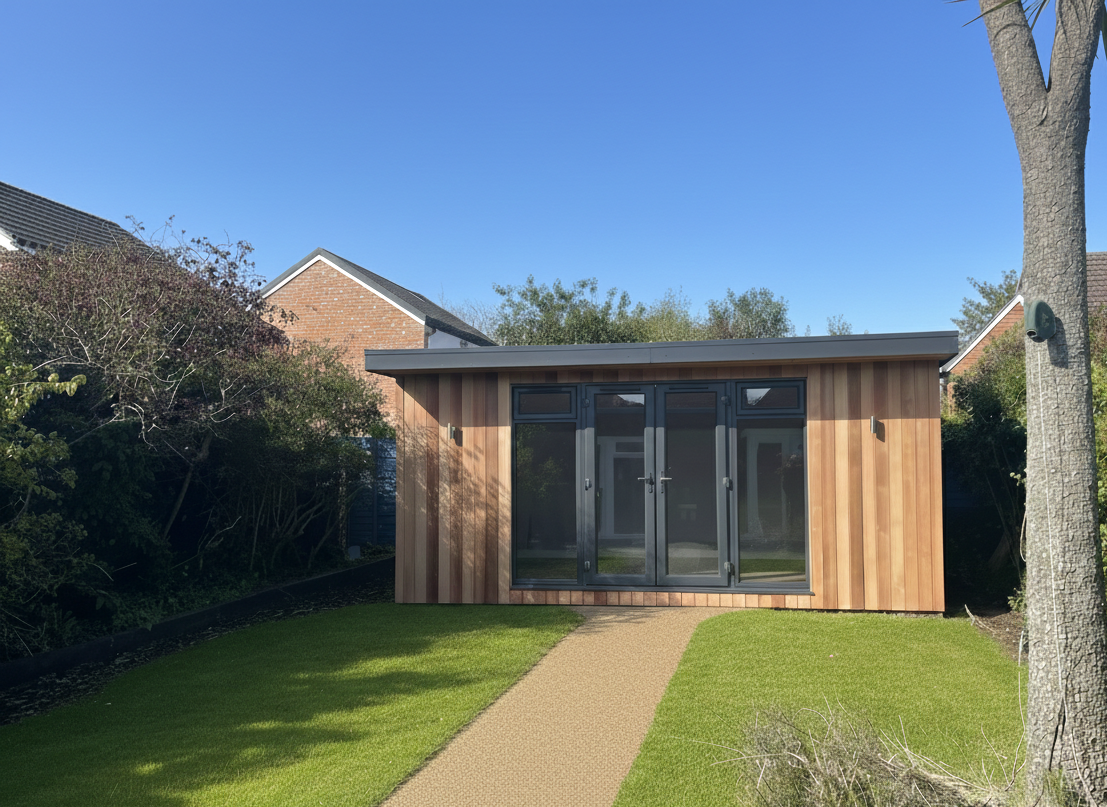
The good news is that with a bit of planning and some straightforward measurements, most homeowners can work out a realistic size range before they even speak to a builder. This guide explains everything in plain terms. Whether your garden is large and open or small and oddly shaped, it will help you work out what is possible before you take things any further.
Start by Measuring Your Available Space
Before you think about anything else, go outside and measure your garden. You need to know:
- The total length and width of your outdoor space
- How much of it you actually want to keep as garden
- Where the boundaries, fences, and any existing structures sit
- Whether there are trees, slopes, or other features that might affect where a building can go
Once you have those numbers, you can start to think realistically about what size building will work for you. A common mistake is to guess at the space and then find out later that the building is too big, or that it sits too close to a boundary.
As a general rule, most people like to leave at least one metre of clear space around the building so they can walk around it, carry out maintenance, and keep the garden feeling open. That space adds up quickly, so always factor it in when you are doing your calculations. If you want to leave two metres on each side, a ten-metre-wide garden suddenly only gives you six metres of usable width for the building itself.
It is also worth thinking about access. If the building needs to sit towards the bottom of the garden, you will need a clear route to get there, whether that is a path, a gap in a hedge, or a gate in a fence. This is easy to overlook at the planning stage but it matters a great deal in practice.
Understanding the 2.5-Metre Height Rule
In England, garden buildings under a certain size can be built without needing planning permission. The rules around this are set by the government and are known as permitted development rights.
One of the key rules is about height. If your garden building has a flat or mono-pitched roof, it must be no taller than 2.5 metres if it is within two metres of a boundary. If it sits further away from the boundary, it can be up to three metres tall with a flat roof, or four metres with a dual-pitched (or ridged) roof.
This matters because the height of the building affects how much usable space is inside. A 2.5-metre building is perfectly comfortable to use day to day, but if you want a full-height ceiling throughout, or you are thinking about a mezzanine level or a raised storage area, you may need to position the building further from your fence line to take advantage of the greater permitted height.
It is also worth knowing that the height is measured from the natural ground level, not from any raised platform or decking. So if you plan to add a step or a raised entrance, that could affect how the height rules apply in practice.
For a full breakdown of these rules, the Planning Portal outbuildings guidance is a reliable and up-to-date source that covers the current rules in plain language.
How Big Can a Garden Room Be Without Planning Permission?
Under permitted development rules, a garden building does not need planning permission as long as it meets several conditions. Here are the main ones:
| Condition | Rule |
|---|---|
| Total footprint | Must not cover more than 50% of the land around the original house |
| Height (near boundary) | No more than 2.5 metres if within 2 metres of a boundary |
| Height (away from boundary) | Up to 3 metres (flat roof) or 4 metres (dual-pitched roof) |
| Location | Must be in the garden, not in front of the principal elevation |
| Use | Must not be used as a separate self-contained home |
| Listed buildings | Permitted development rights do not apply |
The 50% rule is the one that catches people out most often. It does not just apply to the new building. It covers all outbuildings, sheds, and covered structures combined. So if you already have a shed or a garage in the garden, you need to include its footprint in your calculations before you work out how large the new building can be.
It is also worth noting that some properties, particularly those in conservation areas or with Article 4 Directions attached to the planning permission, may have more restricted permitted development rights than a standard residential property. If you are unsure whether this applies to you, it is always worth checking with your local council before you commit to a design.
You can find out more about this on our planning permission rules page, which covers how these rules apply specifically to garden rooms and studios.
Why Bespoke Builds Work Well in Smaller or Awkward Gardens
One of the biggest advantages of choosing bespoke garden buildings over a standard off-the-shelf model is that they can be designed to fit your specific plot, not the other way around.
If your garden is L-shaped, has a slope, sits at an unusual angle, or has a boundary that runs on a diagonal, a bespoke build can be designed around those constraints. The building can follow the line of a fence, step down with a slope, or be sized to fill a specific area without wasting space or leaving an awkward gap.
This is particularly useful in smaller gardens, which are much more common in Essex and Suffolk than people might expect. A building that is eight metres wide will not work in a ten-metre garden once you account for access and the space around it. But a building that is five metres wide, perhaps with a clever internal layout, might give you everything you need and still leave you a perfectly usable garden.
With a standard catalogue build, you are limited to whatever sizes the supplier offers. If the closest option is slightly too wide or too short for your space, you have to compromise somewhere. With a bespoke build, you decide the dimensions and the building is made to those exact measurements.
The key is to think about what you want to use the building for, and then work backwards to figure out how much internal space you need. That gives you a target footprint, and from there you can see whether it fits comfortably within your available plot.
Matching the Size to How You Will Use It
Different uses need different amounts of internal space. Here is a rough guide to help you think about what you are likely to need:
| Use | Minimum internal size to consider |
|---|---|
| Home office (1 person) | 2.4m x 3m |
| Home office (2 people) | 3m x 4m |
| Garden studio or hobby room | 3m x 4m |
| Gym or fitness space | 4m x 5m |
| Garden bar or entertainment room | 4m x 5m |
| Multi-use room | 5m x 5m or larger |
These are starting points, not fixed rules. The right size for you depends on how much furniture or equipment you plan to put inside, whether you need built-in storage, and how much room you want to move around comfortably. A yoga studio, for example, needs clear floor space and benefits from being slightly larger than the minimum. A home office used mainly for desk work can often be smaller than people initially think.
It is also worth thinking about whether the building will need a separate entrance area, a small cloakroom, or a utility space. All of these take up floor area, so if they are on your list, add them into your size calculations early rather than trying to squeeze them in later.
You can view standard layout options and sizing on our room specifications page, which gives a good sense of what fits comfortably within different footprints.
Questions to Ask Before You Get a Quote
Before you speak to a supplier, it helps to have some basic information ready. Having clear answers to these questions will make your initial conversations much more straightforward.
- How much of your garden are you willing to give up? Be honest about this. A building that takes over the whole garden may not feel right once it is there.
- How close is the nearest boundary? This directly affects how tall the building can be under permitted development rules.
- Do any existing outbuildings already take up part of your 50% allowance? Add up all covered structures, including sheds and any covered seating areas.
- What will you use the building for day to day? The answer will shape the minimum size you need inside.
- Do you need natural light from multiple sides? If so, the building will need windows on more than one wall, which may affect how it can be positioned.
- Is there a slope or change in level? This affects the foundations and may change the effective height of the building at different points along the wall.
- Will you need power, broadband, or heating? If so, where cables or pipework run from may affect where the building needs to sit.
A Note on Custom Shapes and Non-Standard Sizes
Most garden buildings from catalogue suppliers come in fixed sizes, typically in increments of half a metre or one metre. If your available space does not match one of those sizes, you either have to compromise on the building dimensions or compromise on how much garden space you keep.
With a bespoke build, you can specify the exact dimensions you need. If you have 4.2 metres of usable width and want to use every centimetre of it, that is possible. If you need the building to be 7.3 metres long to reach the back of a patio area, that can be built precisely to order. The flexibility extends beyond just length and width. Roof pitch, door and window positions, internal layout, and external finishes can all be tailored to suit your plot and your preferences.
This level of flexibility is one of the main reasons homeowners across Essex and Suffolk choose a bespoke build over a pre-made option. The building fits the garden, not the other way around.
Common Sizing Mistakes to Avoid
Even with careful planning, there are a few mistakes that come up regularly. Being aware of them early can save you a lot of time and hassle.
Forgetting to account for wall thickness. The internal dimensions of a garden building are smaller than the external dimensions because the walls take up space. Depending on the construction method, this can be anywhere from 80mm to 150mm per side. Always ask your supplier whether the sizes they quote are internal or external measurements.
Underestimating how furniture fills a room. A room that looks spacious when it is empty can feel quite small once a desk, chair, shelving unit, and sofa are in it. Before you settle on a size, draw a rough floor plan and mark out where the main pieces of furniture will go.
Assuming the planning rules are the same everywhere. Permitted development rights vary depending on your property type and location. What applies to a standard semi-detached house in Chelmsford may not apply to a listed property in a conservation area elsewhere in Essex.
Choosing a size based on budget alone. Choosing a building that is too small for your needs means you will quickly outgrow it. A slightly larger build that suits your needs properly is often better value in the long run.
Ready to Work Out What Will Fit?
Once you have measured your space and thought through how you want to use it, the next step is to talk to someone who can help you turn those measurements into a proper design.
If you are based in Essex or Suffolk and would like to explore what is possible for your plot, you are welcome to request a free quote and start the conversation from there.